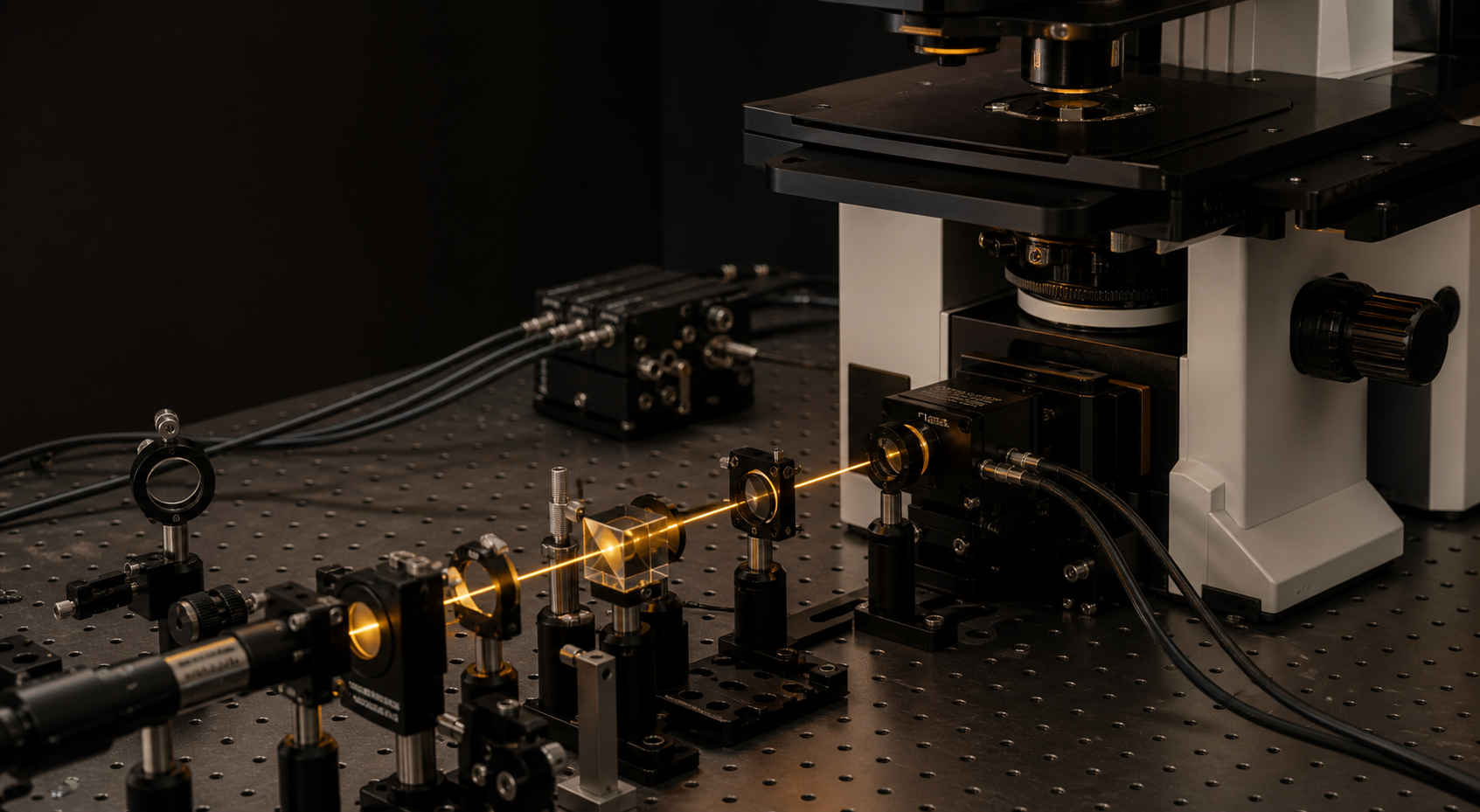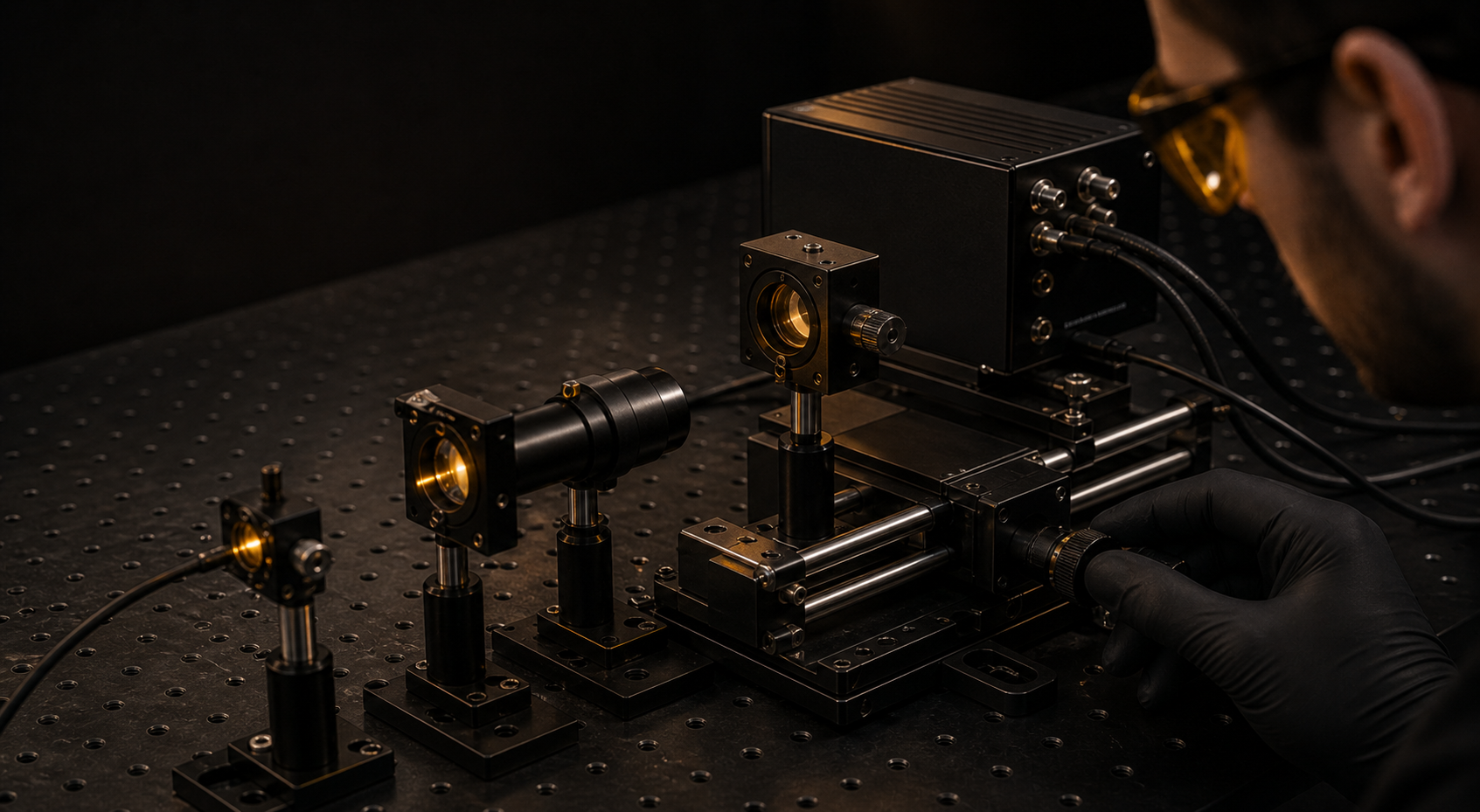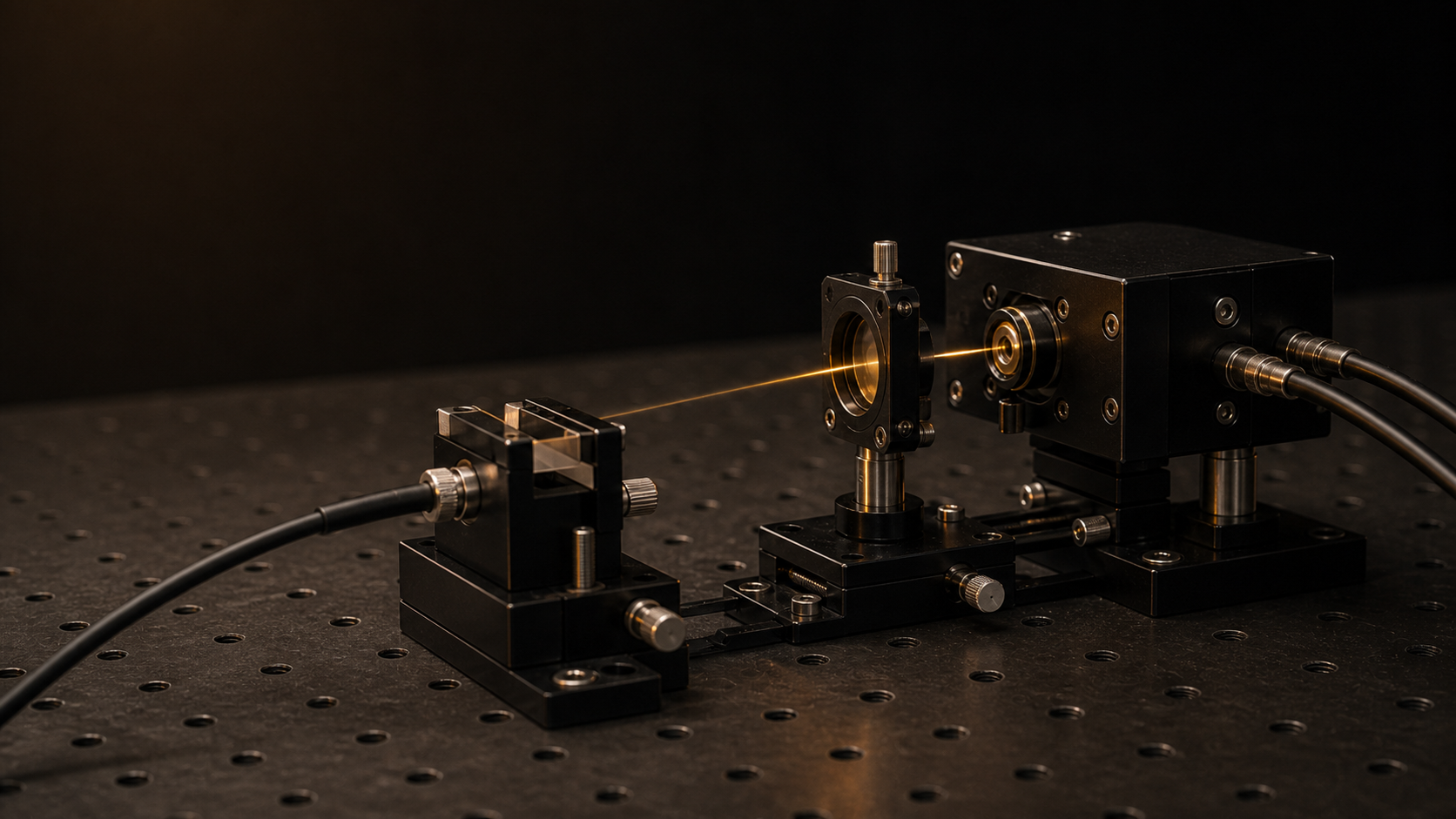
Close-up inverted microscope optics and free-space laser path on an optical table

Democratized super-resolution

Peregrine Photon

We build STED super-resolution modules and custom integrated inverted microscopes for labs that need nanoscale optical imaging.

STED microscopy Few-mode photonic lanterns 50 nm class targets
50 nm class super-resolution targets
Two products module or custom integrated instrument
Optics stack beam shaping, mode control, calibration
Montréal built in Canada, incubated at Quantino

Product Path

Start with a fit review.

We review the microscope, sample, labels, resolution target, users, and timeline. Then the project becomes a module, a custom instrument, or a pilot review.

Start

Fit review

Microscope frame, sample format, dyes, target resolution, users, timeline, and validation.

View product path
Path A

Upgrade an inverted confocal

STED capability for compatible inverted confocal systems.

Super-resolution module
Path C

Resolve unknowns first

Sample, label, validation, or pilot feasibility before a build.

Compatibility review
Mission

Make super-resolution practical.

Peregrine Photon is focused on two routes: a super-resolution module for compatible inverted confocal microscopes, and custom integrated inverted microscopes for experiments that need a purpose-built system.

The goal is simple: give more labs access to advanced optical resolution without making the instrument harder to use than the science itself.

Product Catalog

Two product routes.

Choose a module for a compatible inverted confocal microscope, or a custom integrated instrument when the experiment needs its own optical platform.

Engineering Services

What goes into each system.

Each build starts with the imaging problem and ends with a working instrument: optical design, hardware integration, software control, commissioning, and user handoff.

01

Optical architecture

Excitation and depletion paths, beam shaping, alignment strategy, detection geometry, and photon-budget planning.

02

Instrument integration

Mechanical interfaces, cable routing, microscope access planning, safety constraints, and low-disruption installation.

03

Control software

Acquisition workflows, repeatable calibration routines, user-facing controls, and documentation for daily operation.

04

Validation and transfer

Commissioning images, training, performance checks, handoff documentation, and support planning.

Build Paths

Choose the instrument path that fits the lab.

Path
Best for
Typical scope
Outcome
Super-resolution module
Labs with a compatible inverted confocal microscope
Module integration, alignment, validation
Super-resolution capability without replacing the core instrument
Integrated instrument
Groups developing new methods or niche assays on inverted microscope platforms
Optomechanics, lasers, detection, acquisition software
A research-grade system tailored to a precise experiment
Facility platform
Shared imaging cores and multidisciplinary institutes
Robust controls, training package, maintenance plan
A repeatable system that more users can access confidently

Technology

STED, mode control, and beam shaping.

Peregrine's technology combines STED microscopy, controlled spatial modes, stable beam shaping, and practical microscope integration. Each design balances resolution, signal, sample health, and daily use.

STED microscopy

Excitation light turns fluorophores on. A shaped depletion beam turns the edge back off, leaving a smaller emitting center. Learn about the technology.

Few-mode photonic lanterns

Mode-selective lanterns connect separate fiber channels to controlled spatial modes, which can support compact beam delivery and mode-aware detection.

Beam shaping

The depletion pattern, alignment strategy, and detection geometry are shaped around the sample, dye set, and microscope frame.

Control and calibration

Software and procedures that make alignment, acquisition, and validation understandable for day-to-day users.

Applications

For samples where confocal is not enough.

Cell biology

Resolve subcellular structures, membrane organization, organelles, protein localization, and spatial relationships below the diffraction limit.

Neuroscience

Support fine-structure imaging for synapses, neurites, vesicles, and dense biological samples where nanoscale context matters.

Materials and nanostructures

Adapt optical layouts for fluorescent materials, patterned samples, photonic structures, and measurement workflows beyond biology.

Core facilities

Give shared labs a path to super-resolution capability that can be trained, maintained, documented, and scheduled realistically.

Process

How a project works.

01

Define

Clarify sample type, resolution goal, existing microscope constraints, users, budget, and success criteria.

02

Design

Map optical architecture, components, software needs, safety requirements, and integration plan.

03

Build

Assemble and align the system with staged validation so performance is visible before handoff.

04

Transfer

Commission the system, train users, document workflows, and support the path from prototype to productive imaging.

Company

Peregrine Photon is based in Montréal.

Peregrine Photon combines photonics, microscopy, and instrument-building work for super-resolution systems.

The company is built in Canada and makes retrofit modules and custom integrated inverted microscopes.

Learn about the company

Investors

A product catalog, not a one-off module.

Peregrine Photon is building two commercial routes: upgrade modules for compatible inverted confocal systems and custom integrated inverted microscopes for demanding workflows.

The investment case is practical access: repeatable modules, higher-value custom systems, and support around real imaging work.

01

Canada advantage

Montréal photonics and microscopy talent, with a build story that matters to Canadian partners.

02

Catalog expansion

A shift from one module into two paths: add-on modules and custom integrated instruments.

03

Technical depth

Optical architecture, beam shaping, optomechanics, acquisition control, calibration, and installation know-how.

04

Market pull

Labs and imaging cores need higher resolution without adding unmanageable complexity.

FAQ

Common questions.

Is Peregrine Photon still building a module?

Yes. The super-resolution module is a core catalog item for compatible inverted confocal systems. The broader catalog also includes custom integrated instruments for experiments that need a complete purpose-built inverted microscope.

Can an existing inverted confocal microscope be upgraded?

Yes, if optical access, microscope geometry, safety constraints, target resolution, and workflow are compatible.

Who is the ideal customer?

Research groups, imaging cores, and institutes that need super-resolution capability but want a system shaped around their samples, users, and existing equipment.

What is included in handoff?

Commissioning, validation images, user training, documentation, and support plan.

Are STED protocols included?

Yes. The protocol starter guide covers sample readiness, fluorophores, acquisition, controls, and early troubleshooting.

We Are Here

Peregrine Photon is in Montréal.

The company is built in Canada, incubated at Quantino, and focused on practical super-resolution instruments.

Location Montréal, Québec, Canada

A Canada-based photonics presence for labs, imaging cores, investors, and research partners.

Incubation Incubated at Quantino

Supported by a deep-tech incubation environment for optics, photonics, and hardware ventures.

Direct inquiry info@peregrinephoton.com

Project inquiries open as an email draft.

What happens next Sample, microscope, goal

First review: instrument, sample type, resolution target, and fit.

Start A Project

Tell us what you want to image.

Send the microscope model, sample type, labels, target structure, and resolution goal. We will point you to a module review, custom instrument scope, pilot review, or investor discussion.

Next step Fit review, scope call, or investor follow-up.

Creates an email draft.